







If you have eczema then you’ve probably used Aqueous cream in the past; you may even still be using it as it’s still on the market as a moisturiser for dry skin conditions. Most doctors prescribed it as the first moisturiser to try if a patient displayed with signs of eczema; one of the main reasons being that it’s cheap! So, I was shocked to learn from Dr Adam Fox, Allergy specialist at Guys and St Thomas’s hospital in London that it’s actually bad for eczema. He gave a fascinating talk entitled “Hay fever and allergic rhinitis – state of the art solutions” at the Allergy and Gluten Free show in London last month, where he shared loads of useful new breakthroughs, but this one stuck in my mind.
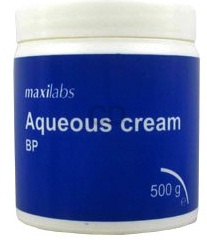
Aqueous cream describes itself as: “Aqueous cream BP can be used as a moisturising cream suitable for use all over the body. It is also an ideal cream for the symptomatic relief of dry skin conditions. This non-perfumed emollient cream helps to soothe, soften and moisturise dry skin conditions such as eczema & dermatitis.”
However, acqeous cream is not quite what it seems. It has been found to actually make eczematous skin worse due to the harsh surfactants it contains.
A study, led by Tsang & Guy, at the University of Bath called, “Effect of Aqueous Cream BP on human stratum corneum in vivo”, investigated whether aqueous cream had a good of bad effect on the skin of people without atopic dermatitis.
The study was published in the British Journal of Dermatology in May 2011, where the article, “The effect of Aqueous cream BP on the skin barrier in volunteers with no previous history of atopic dermatitis” examines the results of the study with interesting conclusions.
Here is an abstract of the article, unfortunately you can’t read the whole thing without subscription to the journal.
Summary
Background:? The emollient Aqueous cream is frequently used for the treatment of atopic dermatitis (AD), yet it is associated with a high rate of adverse cutaneous reactions. It contains the harsh anionic surfactant sodium lauryl sulphate, a known negative environmental factor associated with the exacerbation of AD.
Objectives:? To investigate the effect of Aqueous cream on stratum corneum (SC) integrity and skin barrier function in volunteers with a predisposition to a defective skin barrier.
Methods:? Thirteen volunteers with a previous history of AD (no symptoms for 6 months) applied Aqueous cream BP twice daily to the volar side of one forearm for 4 weeks. The other forearm was left untreated as a control. Permeability barrier function and SC integrity were determined before and after treatment by measuring transepidermal water loss (TEWL) in conjunction with tape-stripping. For comparison thirteen volunteers with current AD were recruited for assessment, without treatment, of SC integrity and skin barrier function at unaffected sites.
Results:? Topical application of Aqueous cream resulted in significant elevation of baseline TEWL and a concomitant decrease in SC integrity. Measurements made after no treatment in volunteers with current AD, at unaffected sites, suggest that application of Aqueous cream negatively affects the skin barrier towards the damaged state associated with onset of flares of the disease.
Conclusion: Aqueous cream used as a leave-on emollient caused severe damage to the skin barrier in volunteers with a previous history of AD. Aqueous cream should not be used as a leave-on emollient in AD patients.
Basically, the results showed that even for people without any previous history of skin problems, acqueous cream thinned the skin, caused significant loss of moisture and damaged even the skin of the healthy participants of the study.
I was amazed to hear this, and to read on the internet more proof that it’s really bad for dry skin. 50% of people with eczema who try it say it irritates their skin so doctors should not be prescribing it anymore. It certainly made mine worse and I stopped using it years ago. If you are still using it and your skin isn’t great, question whether the aqueous cream might be the problem. Go back to your doctor and demand a different moisturiser to try and throw out the old tub straight away.
Apparently it’s not new news. The National Eczema Society had this to say on their website, “Why is Aqueous Cream bad for eczema?”
The Daily Mail ran an article entitled, “The cure with a sting: Eczema cream meant to soothe ‘makes skin WORSE” which puts the blame on the Sodium Lauryl Sulphate in the Aqueous cream. It also has some interesting comments from web readers who recommend Aveeno which does not contain any Sodium Lauryl Sulphate and is super moisturising; I know because I’ve tried this moisturiser on the recommendation of my sister.
Aqueous cream never worked for my skin, I persevered with it for years, but when my skin continued to be dry and I kept suffering from flare-ups my doctor changed my prescription to other moisturisers. I have now settled with Epaderm and Diprobase as my main moisturisers.
I would question whether the Sodium Lauryl Sulphate is the culprit here as I use Epaderm without any problems and on investigation, I discovered that it too contains Sodium Lauryl Sulphate. Just do a google search for the dangers of Sodium Lauryl Sulphate (SLS) and it doesn’t make pleasant bed time reading. Diprobase appears not to contain SLS but it does contain other ‘ium’ and ‘ate’ type ingredients which I don’t quite understand or identify as natural.
So should I still be using Epaderm? Or should I stop using that too? Even though it isn’t irritating me? Now I’ve looked into SLS on the internet I’m not sure I want to be using it anymore… Confused? How can our doctors, who are supposed to be experts in these matters be prescribing these products?

I’ve been told to use aqueous cream many times for eczema and, whilst I can’t say it’s ever made mine worse, it’s been next to useless. I might as well not have used anything at all. Great article.
Thanks Jo! It’s cheap! That’s why they prescribe it. Obviously marketed well. Makes me really cross. It made my skin get worse and worse… There are loads now that are much better. Go back and demand a SLS free moisturiser! Might have do a blog about which brands from the shops are good. Usually they’re the expensive ones unfortuntalely!
This is so right Ruth.
My daughter had terrible ezcema for years and was prescribed Aqueous cream – I went back to the doctor as she used to cry when I applied it and the switched her to Epiderm. I did notice an improvement but I assumed that this was because her skin was changing as she got older – maybe not. Great information to share with us Ruth.
Thanks Lorraine. I know your daughter is very sensitive like me. I am even a bit allergic to the Aloe Forever living sun cream I think. The lady told me your daughter was the only other person who was! Ha Ha. Am amongst good company. Take note though that Epaderm also contains SLS. Check it out out on the internet and make sure you understand all the ingredients of everything you and she use on your skin, as well as what you eat. It all gets absorbed. I will be finding out all about SLS as this shocked me. More to follow…
Interesting blog Ruth. Don’t jump the gun on this. Make sure (as you appear to be planning to do) that your research is thorough and that you include peer-reviewed literature. Good luck!
Ken
Any cream can make eczema worse as they all contain preservatives which are sentitisers and can cause allergies. Thus always use a small amount of cream in one area for a day or two before applying more widely when you use any new cream. It is possible at any later date to become allergic to your cream so if suddenly it makes your skin worse this has happened and will probably always happen with that cream or a cream with similar ingredients.
Reaction to ointments is much rarer as they do not need preservatives if used up to the expirey date. Many people do not like them for obvious reasons of greasyness. Others use nothing else.
Aqueous cream is fine for those who do not react to it and have used it for years. It is cheap and the purveyors of more expensive creams try to get people to use their highly profitable creams instead.
Apply common sense as above.
Clearly those who react to Aqueous Cream are very vocal whilst the satisfied users remain quitely content.
I have no vested interests except comfortable patients.
Hi Colin. Apologies for not responding sooner. Are you doctor? I’ve been trying Shea butter recently. https://whatallergy.com/2012-03/shea-butter-for-sensitive-skin-and-eczema which, as just on ingredient, is amazing. I just worry about all these unnatural things we put on our skin, which absorbs 60% of what we put on it. Paraffin for instance. We don’t even use this to light lamps any more due to health concerns so why do we put it in creams and ointments for dry and sensitive skin? I know I’ve being controversial here and I also agree about the preservatives and stabilisers which can also cause irritation.
Amazing that a low cost product is put down as not a good solution to eczema and other rashes or dry skin. Aqueous cream should be used as a soap, not a leave-on cream. Doctors, drug companies and cosmetic companies always promote high cost/high profit solutions.
I am 52 years old and have had allergy and other skin conditions that cause rashes, itching and dry flaky skin. Nothing that I have bought has been more effective than Aqueous Cream BP. I never leave it on but use it when there is an outbreak 3 times a week as a soap (put it on massage it in and wash it off). It works! Nothing that I have tried even comes close.
dr adam fox is my allergy doctor he told me this straight away when i showed him my eczema the best products for your skin are the ones with as little chemicals as possible.
Does any one know any homemade treatments cause my eczema is really bad at the moment 🙁
Hi Kat, mine is a bit bad too and you’re really lucky to be seeing Dr Adam Fox. I’ve met him and he is a brilliant Allergy Doctor. If only allergy doctors could be like him. Is it this hot weather? Try to cool your skin down with an ice pack or something like that. I don’t know about homemade treatments. I’ll look into this. But you could look at Pure Potions and Spiezia. I find both of these very soothing. Also Gentle Green Ecz-tend soothing cream. Try a cool water bath, then maybe put on some coconut oil. Wishing you itch free thoughts. (she says scratching)
try skin food by weleda, all natural swedish cream that works great
Thanks Amanda, I do like the Weleda brand, very natural product. We should all think more about what we put on our skin, a huge percentage is absorbed into our bodies.
I was prescribed aqueous cream but mixed with small mint crystals (sorry forgot the name of them), and it does actually work quite a bit on my eczema.
I have used elocon which works well and I had used lanacane a few times before, but it did nothing for my eczema, it relieved the itching for a few hours but nothing else occurred.
Also, I have no idea (other than hayfever) what causes my eczema to flare up, do you know what could cause flare ups of it? (:
Hi Elizabeth, well that’s great to hear that you did find Aqueous cream useful. I wonder what those mint crystals were. I’ve never heard of that technique before. I too find Elocon the most useful of the steroids – when I get a bad flare up it’s the only thing that shifts it. I do know that keeping skin really, really moisturised helps me avoid more random flare ups. Hayfever can cause it if the pollen can get into the skin so it makes sense to keep the skin layer as strong and healthy as possible. Not always possible with eczema skin. And if it is bad try to cover up and then if you remove clothing worn outside put it straight in the wash and have a quick shower. But the flare ups, well I know what causes mine but it’s probably different for everyone. Dairy gives me awful eczema. Tomatoes make my skin split open and liquid seeps out, kind if blisters full of something and it’s incredibly itchy – this can lead to eczema flare ups. Broad beans (I’ve only just worked this one out) give me the most unbearable hives imaginable and I think Kidney beans do this too but to a worse degree as they bring on full on massive hay fever as soon as I’ve eaten them. The only other thing is celery which is in so many things but this too either gives me serious eczema or if I exercise, anaphylaxis. The Dairy does this too and I only need to raise my heart rate with fast walking for this to happen – terrifying I can tell you.
Sadly alcohol is the other one. Guaranteed to dry my skin, dehydrate me and make my itchy. Ahaha yes also dust makes my skin come up in hives. Oh the list is long. Keep a diary of your symptoms and not only what you eat but what you’ve been doing. It could be an external thing getting into contact with your skin, like latex or it could be any food. I truly believe that most people, with help to diagnose, could discover what was causing their eczema and the world would be a better place. For me, also, any processed food can do it and i have no idea why. I tend to eat very healthy, home cooked and natural food because anything processed doesn’t agree with me at all.
This article is a load of rubbish. Google aqueous cream and all you find is people suffering with eczema who are all saying how aqueous cream changed their lives.
Hey Mark, you could also google ‘Aqueous cream bad for eczema’ and you’ll get a whole load of stuff about people, me included, who find it makes their skin worse. It is meant as a wash off product for cleansing I think, but does contain ingredients which can irritate sensitive skin. My blog, my opinion. I don’t like the stuff.
The doctor prescribed this for my son when he was really little and had bad eczema. It made his skin look like it was burnt but they kept telling me to apply it more often! I stopped and got a new cream but it is interesting to see this study.
Nasty stuff! I used it for years and my skin was just so awful and the miracle when a different doctor swapped me to an ointment (Epaderm) was incredible. Sometimes I think doctors are just thick. Probably just that they don’t know though. Aqueous cream is VERY cheap so that’s their first line of prescription but it’s such nasty stuff, for my skin anyway. Glad his skin is improving. Generally ointments are better as they contain less preservatives. Good luck!
Aqueous and Other Glycerin creams do not work for me even though they were prescribed to me. If you like me have extremely dry flaky skin, try the Citrus Clear Skin Repair Moisturizer – it moisturizes so well its very rich and nice citrus scent. I don’t suffer eczema but my skin is just so dry that I couldn’t wear foundation in the past but not anymore.
Hi Ruth, after reading about he problems related to SLS in aqueous cream but not convinced that is the main problem, as I am mainly allergic to natural things i find that the more petroleum, liquid paraffin type products that are in the product the worse my flare up gets, so i tend to use the Dermol range of products like Dermol 500 as a moisturiser dermol shower cream for washing etc as it t most only contains 2.5 to 15 % liquid paraffin where as i have noticed that most other aqueous creams contain far more than Dermol does. I have also noticed that some of the others list soft paraffin as well as liquid paraffin in varying amounts up to 30% of the product is a petroleum based product which is also a major irritant to most people let alone those that suffer.So those that are already inflamed i would think that putting things like liquid paraffin is firstly going to sting and secondly i think make things worse, what do you think. Ian