








Do you have sudden, strange and unexplained allergic reactions to gluten free and other freefrom foods?
You know you’ve checked the label and everything looks to be safe… Maybe you are even reacting after food cooked using gluten free self raising flour but you just can’t work out what’s causing a problem?
Well you’re not going mad, you may be allergic to xanthan gum which is used to replace the missing gluten that is lacking when you don’t bake with wheat based flours.
Or you may just be struggling to process or digest it, not an allergy but still not great for the gut.
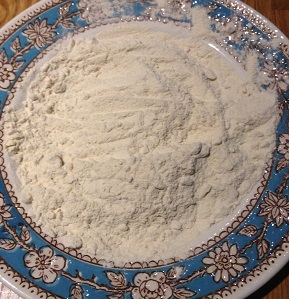
It sounds like a character for Willy Wonkers Chocolate Factory or maybe even a nasty disease of the mouth.
Xanthan gum can be found in so many things from toothpaste to ice-cream and as it has thickening properties it has been adopted by the gluten free baking industry as a pretty good way of replacing that missing gluten that makes normal wheat baked goods so springy, moist and strong.
Gluten helps bind bread together so when it is lacking the bread or cakes produced can be very dry, flat, solid and unappealing.
So what exactly is xanthan gum?
It doesn’t take very much research to discover that “It is produced by the fermentation of glucose, sucrose, or lactose. After a fermentation period, the polysaccharide is precipitated from a growth medium with isopropyl alcohol, dried, and ground into a fine powder. Later, it is added to a liquid medium to form the gum.” (source: Wiki)
The word lactose should already be ringing alarm bells.
It appears that xanthan gum can be grown on sugar from dairy, soya, wheat or corn yet it rarely declares which medium was used to grow it.
A bacterian is used to grow xanthan gum which causes cabbages to rot! Lovely! I hear you cry. Pass me some xanthan gum right now.
However it’s considered to be relatively safe and is very cheap to produce, very stable and works miracles with gluten free bread.
How do you know where your xanthan gum originated from?
Have you ever seen a label with the source of the xanthan gum listed? My research didn’t throw up an figures about the amount of the allergen which may or may be present in the end produt but it could be a frustrating journey trying to discover what it came from. In fact on Doves Farm xanthan gum it says it comes from a few different countries so it would take a while to work out what the mix consisted of.
Tracing where xanthan gum was actually derived from is proving harder than I thought but I’m on the case. If you suspect it may be causing you a problem, try to find out the source. I think it should definitely be labelled and wonder why it isn’t already.
Doves Farm have responded however to assure me that the xanthan gum they use is grown on corn, the least allergenic of the base ingredients so it should be OK for most people. Lots of people do have a problem with corn though, so I’m not sure if there is a safe form to use.
At no point have I ever been told that xanthan gum could be a potential threat to my health, even though I am allergic to wheat and soya.
There is always the possibility that someone could be allergic to all xanthan gum, the bacterium it is grown on could cause an allergic response too. People can be allergic to the strangest things.
There must be another way to bake gluten free without xanthan gum…
Eating fake foods which are processed unnaturally seems like a bad idea for me, we know from recent news that processed meat can increase your risk of heart disease and cancer, so why not other processed aritificial food stuffs too?
When you try to find products on the shelves of supermarkets that don’t contain xanthan gum you realise just how widespread its use is. It’s in so many things.
Some bakeries don’t use any man-made synthetic gums or other additives. They use natural simple ingredients. It is entirely possible. Check out Knife and Fork Bakery, who do not use xanthan gum in their gluten free bread.
I have also noticed recently that M&S gluten free use guar gum. This was true for their gluten free crumpets but I’m not sure about their bread or other #GF stuff, worth trying if you think xanthan is a problem.
Guar gum, by comparison, whilst processed to some extent is the powder from the gum of the guar bean so it’s far more natural and should pose less allergy risk.
So, to xanthum or not to xanthan, that is the question. One the most important lessons I learnt whilst writing this blog post is how to actually spell xanthan gum… I think both spellings are correct, one American and one English spelling.
Does it only pose a problem for highly allergic people? How much allergen may be present? More research needed because I didn’t find all the answers but I will update this blog post as and when I discover what’s that.
Are you allergic to xanthan gum? Do you react when you eat products containing it? Or is just a harmful ingredient?
Alternative ingredients to avoid using xanthan gum
There are a few things that you could try, including psyllium husk, arrowroot, flax and chia seed and Konjac powder.
What is methyl cellulose?
There are other nasty ingredients in gluten free processed free from bread including gums, fillers, things like methyl cellulose which is basically cardboard! We really shouldn’t be eating these ingredients so if you can avoid them please do.
Methylcellulose, or methyl cellulose, also known as its abbreviation MC. It is made from cellulose and can be used as a thickener, emulsifier, binder, stabilizer and gelling agent in food with the European food additive number E461. It is also a fiber supplement. It is a water-soluble polymer chemically modified from natural cellulose by partially etherified it with methyl groups. For more visit the Food Additives website.
From the BBC website cellulose is described as:
Cellulose is the main substance found in plant cell walls and helps the plant to remain stiff and strong.
Humans cannot digest cellulose, but it is important in the diet as a source of fibre.
Cellulose is used to make clothes and paper.
So manufacturers are adding an ingredient that is the major component to make clothing and paper and cardboard? Why are we even thinking of eating this? The long term effects are not understood and I’d rather wear it and write on it thanks!
Further reading about xanthan gum
Celeste explains why she no longer uses xanthan gum: Why I no longer use Xanthan or guar gum



I don’t think there is such a thing as xanthum gum. It’s xanthan gum.
Thanks Donna. How have I not noticed that my whole life? I have updated the blog… Thanks for pointing that out, a copywriter should really get the spelling right the main topic of discussion! 2/10 see me. Write one hundred times: It’s not xanthum gum it’s xanthan gum
A lot of people can eat xanthan gum with no problem. Not me! The advice online is it is only a laxative in large amounts. Well the tiniest bit of it in coleslaw or something leaves me with diarrhoea and nausea. It seems to be getting everywhere not just in gluten-free stuff. I wish they would be made to put it in bold so I could find it easily and not waste money or knock myself sick.
The only gluten-free bread I can eat now is warburtons as the rest all use that damn stuff.
Argh that must be a nightmare. It really is in so many things. I try to avoid it too but don’t have such a bad response to it as you. I guess on the plus side you are eating more healthily out of necessity. Stay safe and avoid that toxic stuff. I don’t think humans should be consuming it.
The xantham gum from ‘Life free from’ says it is wheat and gluten free, as well as nut free and suitable for vegans (so I assume no dairy).
Thanks Liz. I also checked with Dove Farm and The Foodamentalists and both use corn derived xanthan gum so perhaps we are worrying for no reason. Worth knowing though as could explain the unexplained attacks when we can’t check the origin!
but it can also be made from corn & soy, so Liz, if you are allergic to those, it would explain a reaction. My family cannot have wheat, barley, rye, corn, soy, dairy. Every company is different and it takes contacting each one to question the source of the xanthun gum. One company told me they use soy, but the fermintation process destroys the soy allergen by the end. How do I know if that is true??
They say a lot that the processing removes proteins but I’m never sure I believe this. So hard to find out, and it’s a processed ingredient, so if you can avoid using xanthum gum, even better!
We have advised against consumption of xanthan gum on the TrulyGlutenFree site for ages ever since I discovered it in supplements, let alone foods. I am told much of it nowadays is fermented using corn sugar, as that is the cheapest source. The problem is, as you say, you can’t tell and it can vary without even the supplier knowing, as it depends on what source is cheapest at any given time. There is no obligation for the manufacturer to tell the product supplier when the source changes. Nightmare.
Fermented products, like some supplements, enzymes, food additives etc, are a real problem generally since, as you can tell from this, they have to use a fermentation substrate – a sugar – and that is usually corn-based from what I am finding, although it can be the sources you mention. Most people won’t react at this level , of course, but you can and a lot of my readers/patients do.
Thanks Micki, and as I am realising, I am not most people. Am on a pick it kill it diet at the moment. No processed foods at all and feel so much better already. Husband did buy a packet of those lovely kettle crisps for me, the unsalted ones, so Might have to make an exception for those. Ha Ha. The more I read about xanthan gum the more disgusted I am, all these fake, manmade ingredients can’t be good for us. I’m avoiding it if at all possible from now on. No mean feat I know, but as I’m pretty sure it’s possibly the culprit for some pretty horrendous allergic reactions it’s no great loss. My doctor can’t believe what I’m allergic to and the list keeps rising!
Like that: pick it, kill it. Welcome to TGF world! Nothing processed goes in at all as it’s just not worth it. Hope you enjoy cooking…!
Hi Micki, I’ll check out your site. But for now, if I throw away the Xanthun Gum, what should I purchase to use in my flour mixture for baking to be the “glue”. I also thicken my soups when making cream soup, so a universal thickener would be great. Please include original of whatever ingredient you recommend. thank you so much. Cindy
Hi Cindy, You could look into psyllium husk, which is used to help with constipation but in it’s powdered form can work great as a gluten replacement. Also look into Arrowroot to thicken soups etc. If you can use Corn, corn flour also works well as a thickener.
I went into anaphylactic shock due to xanthan gum allergy! Thank you so very much for putting this information out there!
Warning about both Xanthum Gum AND Guar Gum if you have had stomach or intestinal surgery:
Beware both. Eat small doses until you know how you will react. My experience is that post stomach surgery, I was forewarned about guar gum to avoid it equal to avoiding pastas, especially spaghetti. Pastas and guar gum were known to my surgeon at the time to cause extreme discomfort in patients who had stomach or intestinal surgery. Symptoms – “If you feel like you have a balloon being blown up inside you, making it difficult to breathe, and you are bloating up like a balloon as well, chances are you have had an experience with one of the “gums”. That fermentation — in my opinion is dangerous stuff. For me, both are horrid – almost worthy of a visit to ER! Usually the after effect is I can’t eat for at least a day, sometimes several, until the symptoms subside.
Meanwhile, you may find your heart racing, blood pressure rising rapidly and your body in a state of panic – cold sweats, light headed, feeling like you are struggling to breathe – when this happens to me, I feel like I am being “strangled” inside-out. Your stomach can feel like it is expanding to stop your lungs from fully expanding to breathe.
If you have found you got into this stuff accidentally – – (become a paranoid ingredients label reader – it will help) one thing I have found that will sometimes cut through the pain and extreme discomfort fairly quickly is to sip (very small tiny drinks) of Coca-Cola. It will help dissolve the blockage. My surgeon had also suggested drinking Adolph’s meat tenderizer mixed in water. It takes awhile (for me at least) for the symptoms to go away.
I have found this nasty goopy gum in everything from wing sauces (for chicken wings) to chain restaurant stir-fry’s you would find in the frozen food section at a grocery store.
Report any adverse reactions. It’s the only way these additives can be stopped from being sold. The major chain restaurant I contacted told me flat out that since they don’t hear people complain about it, they don’t think they owe an apology. I didn’t want an apology – I wanted to warn them their product might actually kill someone who has had a shortened intestine or stomach made smaller for any reason.
These two gums are very, very scary. In my opinion, these should be considered to be pulled off market – or – at least carry a strong product warning!
It’s not a food allergy – it’s a fermentation problem with the Gums.
Thank you for this comment! I have had 4 increasingly more severe reactions over the past year. It took me months to figure it out because Xanthan Gum is such a small additive. The last episode almost sent me to hospital due to abdominal pain (which you described perfectly), chills, and disorientation.
If I ever have another episode (please God, no!), I will remember the Coca-Cola and meat tenderizer tricks. Thank you so much for sharing that!
I’ve been newly diagnosed with a corn allergy. I react to xanthan gum MORE than corn-on-the-cob.
First time was a fajitas seasoning pack containing this gum. I broke-out in hives. My allergist has me following the paleolithic diet due to my apparent sensitivity to food additives/preservatives; this seems to be helping.
Last night I almost had to use my epipen from eating a slice of gluten-free cake from a gluten-free bakery! I assume it contained xanthan gum; being my birthday (27th) and just a small slice, I thought it would be ok. I’m still having throat swelling this morning.
I’m trying to eliminate common ingredients in certain foods that are making my two year old break out in hives around the mouth and face immediately after eating them. This is a common ingredient listed however it’s also listed in other foods that don’t cause a reaction. Could it act differently in some foods, than others?
Hi Amanda, I have this exact problem too. I haven’t gone into it exactly but there are many manufactures of xanthan gum and also they can be made using different starting cultures. It is almost impossible to find out this information but it’s one of the things I would love to do when I get more time. I think xanthan gum in doves farm flour is OK for me, but in some smaller companies, it’s not. I think it could well be some types are bad and others not but I have no idea why. Confused? Yep me too,
Hi there,
Interesting writing. I, too, am suspecting that xanthan gum may be my culprit. I’ve been gluten-free for two years and dairy-free for a year. About 6 months ago, I started reacting to something I’ve been eating. This has happened three times now and I have ended up in the ER. Symptoms are lips and tongue tingling and goes on to tingling in my entire body, chest tight and hard to breathe feeling somewhat paralysed, faintness, elevated heart rate and feels as though my blood pressure goes up and down, headache. The ER docs said it was not an anaphalactic reaction because I had no swelling and rash and he couldn’t do anything for me (they felt that Epi-pen or steroids might actually make me worse–my body was in a state of extreme neurological “excitement”). I contacted my allergist and he wants me to write down all food and ingredients I ate on the days I was affected. Guess what the common ingredient is? Xanthan gum! Also, rice flour because it’s in so many gluten-free items as well. Anyway, I’m going to be tested on Monday and might have to even eat some xanthan gum there and see if I react. My symptoms are extreme–they fill my whole body and head–and last for 5 days. I feel like I’m poisoned. I’ll report findings back. P.S. I read that if you have a mold allergy, you may also be very allergic to xanthan gum because it’s basically a mold that we are eating.
Hi: I am allergic to Xanthan Gum. I tried eating gluten free for one week – oatmeal from Whole Foods with Xanthan Gum – Subway sandwiches gluten free -Xanthan Gum. In one week, my heart started beating irregular – took me a few days to figure out what was going on. It was the Xanthan Gum. It is in so many foods. Xanthan Gum has been around since 1968 (approved by FDA). I have always got an upset stomach eating ice cream (Xanthan Gum) for example. I know now that I am not allergic to gluten – I am allergic to Xanthan Gum. I wish that people eating “gluten” free would realize the dangers of Xanthan Gum.
Well I definitely have a reaction to xanthan gum , burning, bloated stomache just like if I have eaten wheat, am looking for other alternatives, I have tried baking my own bread but nothing has worked so far, really gets me down, I have spent hours on the web trying to pick up tips, as you can probably tell I am new to all this gluten free living, I was tested for coeliac disease which came back negative yay, but that was when the doctor lost interest and basically sent me away to work it out for myself. soo here I am slowly working out what I can and cant eat, but was gutted when I established I had a problem with xanthan gum too. Will try M&S and see what is in their gf bread. :o(
THANKYOU CAESI for tip of sipping coca cola. I have been so uncomfortable all day as I had not checked a label and ate something with xanthan gum in. I am sipping cola as I write and already am feeling the burning bloated symptoms are easing. Feel sooo sorry for the people who have more severe reactions, it makes me feel that I should not be so miserable because it could be so much worse. :o)
Hi All,
I realized from the latest comments, that I forgot to post my findings on the allergy tests I took last year. Here’s what’s been happening: I, together with my doctors, have determined that I am having histamine-intolerance reactions. I was tested for an allergy to xanthan gum and it came out negative. HOWEVER, many regular allergy tests do not show a histamine sensitivity. So, I went on a histamine-intolerance diet (in addition to gluten-free, migraine-free, dairy-free) and felt better. However, symptoms still continued, although a histamine-free diet did help quite a bit, but there was more. I saw an Integrative MD who specializes in intestinal problems. I was tested for h.pylori which was negative, but also for SIBO (small intestine bacterial overload) which was skyrocketing high!!! It was one of the highest the doctor has ever seen (her next highest patient is bedridden) and she thinks that’s responsible for me reacting to so many foods–even digestion itself can cause a histamine reaction no matter what I eat. My case is so extensive that my central nervous system is impaired (sometimes I think that it’s permanently damaged, but I obviously hope not). So, we’ve been trying to kill the SIBO. BUT, the act of trying to eradicate it is also giving me extreme reactions (MAJOR, MAJOR MIGRAINES like I’m going to have a stroke any second). It’s been a long haul. I have found, however, that a simple thing like Gas-X makes a difference in how I feel because SIBO causes huge amounts of methane and other gases to circulate in your body and disrupts the serotonin process. Extreme histamine reactions, however, can also be caused by things, other than food. Emotions, heat, pain, immune disorders, menopause and more elevate histamine. Histamine is actually a beneficial substance, but it can go out of control. I also found I’m low in Vitamin D. However, that has not been easy to remedy either as I’ve had major reactions to supplements and I even have a histamine reaction to going out in the sun. I’ve been tested for malnutrition, also, and, yes, I am actually malnourished, which is shocking in America. Anyway, it’s been a VERY long haul. I’ve had so many bizarre symptoms and sometimes feel like I’m going to die any minute, but my doctor is guiding me along and we’re finding solutions bit by bit. The more this goes on, it’s more apparent that my issues are digestive which affect my serotonin which affect my central nervous system. Add in low Vitamin D and Adrenal Exhaustion. This whole thing blew up at menopause. So, my plan? Slowly add in more digestive enzymes, natural supplements to kill the SiBO, elevate my Vitamin D level, rest my adrenals. I have found that restorative yoga and meditation help quite a bit. Also, working with nature–i.e., going to bed at 10:00 because apparently hormones go through a cleansing and refreshing period from 11:00 pm-1:00 am. If you’re a night owl (which I was), you’re not getting the refresh, night after night–so never. Also, only organic foods, chemical free, etc. Positive thoughts, worry less to raise serotonin levels. It’s really a whole revamp of my life. I’m 58 and going through a re-birth, so to speak. All of these symptoms are trying to tell me something. After several years of trying to be “fixed”, I’m finally listening to my body and the world and realizing that I’m a very sensitive person that feels everything (although I already knew that), but that as such, since I can react to the bad, I can also react to the good. I close my eyes and listen to myself. If something doesn’t feel right or good, I immediately stop doing it. I meditate. One meditation CD that I’ve found very helpful is one by Becca Pronchick. Look her up on the web. And, I realize that I didn’t become this way overnight. It’s really been a buildup of years of stress–even from childhood–, eating, sleeping, thinking habits that have finally caught up with me. It’s really been a wonderful opportunity to question my inner self and realizing what’s not working in my life and as long as I’m still alive, I do have an opportunity to change. My body reacts to everything–what I think, what I am, what I eat, stress, sleep, light, sound, allergies from outside–everything. I know, it’s been VERY HARD, but I truly think I’m coming out of this a better person. I’ve definitely come to realize that this rush-rush modern world is not good for me and that I’m embracing a more old-fashioned life (which, of course, had it’s own kind of stresses). But, it’s been an opportunity to find my own truth. It’s been an opportunity to find my own spiritual way. It’s been an incredible journey. All my best to everyone out there who is struggling. Please listen to yourself, your body and mind. You do not have to follow the same path that you’ve been on. A new path may be what you’ve been seeking. It’s taken me years to see this and it’s been an INCREDIBLE struggle with much pain–physical and emotional–but, I’m now finally appreciating where I’ve been and where I’m going. I have more hope with my situation than I have ever had before. Much love to you all and the world. Truly, Elisabeth
Elisabeth, I am sorry to hear your struggles but glad you are finding a path through it then. You sound just like the healing series of posts I am writing as I discover my own way through this ‘journey’! Do read the one on CSS Central Sensitivity Syndrome especially; it might help you I think. Start from the oldest posts and work up. Good luck! http://trulyglutenfree.co.uk/
Thank you, Micki. I so appreciate you taking time to write to me and everyone on this site. I have looked at your blog and will read it more thoroughly when I can, but it looks so interesting. Yes, I have identified an emotional component to my situation. I have been delving into that deeper with therapy and EFT. The body and mind are one; what happens to one affects the other. I think this journey is for the rest of my life and something that I won’t just “get over”. It will take much self-exploration. I very much appreciate reading about your experiences and your advice and once I’m able to read all of your entries, I would like to correspond again. Thank you so much, Micki, and all my best to you. Lots of love and peace. Truly, Elisabeth
Pleasure, Elisabeth, glad it helped. Good luck with your journey then!
Yes thank you Micki, I think perhaps I need to look into this too, but for me I know certain foods trigger quite serious reactions. I’m not sure fixing emotional problems will help with that but I am positive that it might help with the IBS and general eczema symptoms.
I think it’s a combination of approaches, Ruth, rather than any single one. I have certainly found that some of my symptoms can be ‘talked down’ if you will whereas others need a more physical healing approach. The way I see it is that if I can solve some of it with the psychological approach – and not least become less fearful of it all and more able to heal – then that can only be a good thing. Good luck!
Hi Micki, yes it’s a million small changes and little lessons that together make for a far more enjoyable life. Shame that on occasion I make millions of tiny mistakes all at once culminating in massive overload and flare ups ;o) All good here in the what allergy household though.
Hi Elizabeth
I’ve been really interested to read your account I’ve been struggling lately with a few things and have wondered if I t may be SIBO. I have an issue with gums, gluten, dairy. I’m starting with menopause and my stomach is bloating all the time. I feel stuffed. My scalp itches and I’ve had hair loss. I’d be really interested to know the protocol to get rid of the SIBO. Idiot know where you’re based but I’m not sure doctors here would entertain me with it.
Regards
Cath
My allergy is to xanthan gum, and barley and check out this article showing that barley is treated twice with xanthan gum to kill a fungus before it can be used in production. Know wonder I cannot have it.
my allergist said theres NO TEST for allergy to Xanthan gum?
I am VERY sensitive to both guar and xanthan gum , with bad hives etc etc . I am also a
Coeliac . One of the more regular ‘ next day ‘ results is mental disconnection . I can’t work
out ‘change’ when shopping . I blank on everyday words or names , and given more than
two tasks to do by my wife will forget the second . Perhaps that is just being a man . I am
Well , but in a vacant state and unconnected to what is going on around me . It makes me
feel that there is a connection between modern diet and the rise of dementia . As a ps I
always loved sherbet flying saucers , but had to give them up as the next day I would feel
hugely depressed . Anyone found the same ? (These are a type of candy for our US pals).
I am fifty eight years old and looking back at school days and early employment and being
harassed for being slow or un commited I feel a relief that it was due to diet ignorance by
myself and those who might have known better . Thankfully the world is a wiser place now
and so much more in the way of foods is available to us .
Interesting article! I knew that gum had xantham in it since I like to read labels, but I honestly had no idea where it came from or what it consisted of. Everything needs to be broken down once digested, and gets converted to inert metabolite for excretion. (insert linkhttps://www.drlam.com/blog/reactive-metabolite-response-adrenal-fatigue/29186/)
I am actually allergic to xanthum gum I avoid everything that has it in it at all cost. It affects my gastrointestinal in a way that it resembles a person who has celiacs disease. I have bloody diarrhea, and it breaks down my immune system for 3 days. My allergist can’t explain the why for my symptoms but I am basically on bed rest for the entire 3 days. It’s really dangerous for me to consume foods with it in its ingredients due to the gastrointestinal effects that could lead to a colostomy bag if continued consumption. I read all labels and it’s located in everything from salad dressings to cake. I have learned how to eat cautiously and not take any chances with eating something that doesn’t list ingredients. When eating out I choose eateries that use fresh ingredients. I wasn’t always allergic to it I developed the allergy like I did with peanuts and shellfish along with red40 in my mid thirties. I hope this helps someone but it’s not entirely bad due to me really paying attention and researching my foods now,
I can imagine that must be a nightmare. I’m not allergic to it but I don’t like it. It’s difficult but there are much more natural alternatives if you search around. For great I love the natural Rye loaves and Artisan Bread Organic who don’t use any xanthan or other gums. Thanks for sharing.
I have tinnitus. I got off of gluten and started eating gluten free. I noticed my tinnitus got worse until I realized gluten free products mostly have xanthan gum which I think has elevated my tinnitus I thought I’d mention this to help anyone else who is having the same issue.
I watched a rash “crawl” up my arm the second time I ate a gluten free product.
Ouch! Do you know what it was in the GF product? Now starts the detective work to find out what’s causing it. I find a lot of GF products to be not that good for your health, the ingredients list can be long and weird stuff too.
Yeah
It was from Whole Foods: individual size cheese cake and chocolate cake, I check all the contents the only think new was Xanthan. I waited a week between products. The second product caused an immediate reaction “after the last bite”.
It was the only time I was worried about using my epi pen.
Hi!!
I have an anaphylaxis allergy to Xanthan Gum! It drops my blood pressure within 5-20 min of eating and if I don’t use my epipen, I’ll pass out and start a full “traditional” anaphylactic reaction. I was blood tested and it came back positive with my Allergist. I’m the 3rd patient he’s seen in his 25 year career and the only one with a cardiovascular response. I’m very thankful I found your blog, as it’s really isolating and have to make everything from scratch or sincerly Research the restraunt prior to going out to eat or it can/will kill me. I’m leaving my email here if anything wants to connect as it has changed my life completely on 12/24/22 and I’m only 35 years old and it’s a really lonely and scary path. Please reach out anytime as I know it’s rare and hard to find to discuss with anyone. ac_sulli@yahoo.com
Gosh that sounds really scary as this stuff is in so many different foods. It really takes a switch in mindset to concentrate on what you CAN eat and what you CAN do, but I know how rough it is, but you are NOT alone in this. Your allergy is very rare though! I guess you need to avoid all processed foods? I do that anyway as I’m allergic to a whole collection of stuff. what things do you struggle with most?
I was diagnosed with petit mal epilepsy when I was 11 years old, in 1973. I was on seizure medication for 43 years. I was getting sicker and sicker. A neurologist finally put me in a seizure clinic for a week of constant monitoring without medication. I was told I didn’t have seizure at all. I immediately made an appointment with an allergist. It came back that I was having anaphylaxis allergic reaction to xanthan gum. That was 6 years ago. I’m doing so much better now. I’ve been off of all seizure medication since 2018, it took that long to wran myself off. Now its just recognizing what I can and can’t eat. Honestly, the cleaner you eat, the better off you are. I also make my own baked goods, marinades and salad dressing.
WOW that’s awful how long it took you and the strong meds you were put on. I am so glad you are doing better. I’m going processed food free again and hoping i can make more stuff from fresh. Thanks so much for sharing. Just proves how complex allergies can be.
I am allergic to xanthan gum and have to carry an epipen. I am not allergic to soy, dairy, wheat, broccoli, cauliflower, nor kale. I believe the bacteria used to make xanthan gum which causes mold on cauliflower is what I am allergic. I do not tolerate mold well. It took me 10 years to figure out but I knew fake cheese sauces, milk shakes and gravies were a problem. First incidence was with an off brand egg not that made my throat scratchy and started to swell so took benadryl which relieved symptoms. In 2018, I figured it out and have stopped all products with XG. My seasonal allergies have decreased significantly and I am alot healthier. I think Xanthan gum should be banned world wide due to it killing infants which they attributed to immature gi systems. It is not a wonder ingredient but rather another lab created ingredient that is toxic to some people.
Thanks so much for your comment Kathy. I agree, it’s a nasty ingredient and i try to avoid it too. It’s in all processed foods and by avoiding most of these I am able to cut it out of my diet most of the time. I slip up and every now and then, but I get a rather milder reaction, just on my skin if I have gluten free products for instance. Though I think I also have a problem with some of the other processed food nasties too. Problem is, each product has so many of them in it you can never pin point the culprit! Stay safe and vigilant and thanks again for your lovely comment.