








Have you ever heard of tung oil? It’s pronounced ‘tongue’ and certainly didn’t make me think of nuts when I first saw the can. My husband bought some after doing in-depth research into the best oil to treat un-oiled oak kitchen work tops for our new kitchen. Have I mentioned the new kitchen? It’s very shiny and new and exciting at the moment – the novelty will soon wear off.
Back to the tung oil, it resists liquid better than any other oil, is far more resistant to mould and it’s environmentally friendly – perfect for a kitchen work top. Or is it?
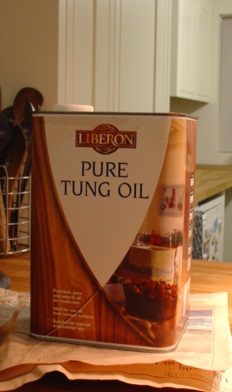
Well, anyway, the oiling was going well, three coats in and Mr What Allergy suddenly looks a little sheepish when he returns from work. It appears that the fantastic, whizzy, all singing, all dancing, best-ever-for-treating-oak-work-tops, tung oil was a wolf in sheep’s clothing.
Tung oil is a quick drying oil which is made from the seeds of the nut from several species of Aleurites, primarily Aleurites fordii, a deciduous shade tree native to China and Japan. It can also be found in wood finishings and the composition of oil paints and printing inks, as well as in its pure oil form. Oils sold as teak oil can in fact contain tung oil.
The word that stands out in the last paragraph is that horrible little word that strikes fear into every nut allergic’s life – NUT! People with a nut or tree nut allergy can be allergic to tung oil, either on contact or even inhaling the odour. Watch out because it can be used to treat other things, not just work tops including kitchen items such as chopping boards and wooden bowls.
Castor oil and linseed oil would be a much safer alternative but these both take much longer to dry and can leave an oily residue until they soak into the wood surface.
Now you might be wondering whether I suffered any adverse reactions to said tung oil. I was wheezing a little, but then I was also unpacking boxes which were dusty so can I blame that on the tung oil odour? It has quite a pleasant smell actually and is not too strong. It certainly doesn’t seem to smell at all nutty. I hadn’t done any of the actual oiling myself, luckily, and what a shame, now I cannot take over the role for fear of a nut related allergic reaction. There is always a silver lining when allergies excuse one from nasty, boring jobs. It’s a job that needs to be done regularly, quite often at first, then less often as the wood takes on the oil and becomes completely impregnated. Special care needs to be taken around the sink where more water will come into contact with the work top.
What could be a problem is contact with the oil when wet, especially where food preparation is concerned. Another question is how long does it take to dry, how long do we need to keep oiling the wood for and will the worktops be a danger when dry to anyone with a nut allergy?
Well, so far, so good. I had a very mild swelling on a paper cut where I hauled myself up from stacking stuff in a new cupboard by leaning on the work top and the cut came into contact with the oil. It stung a tiny bit, but paper cuts do that anyway, so after a quick wash under the tap it seemed to calm down pretty quickly. Would it have swollen up regardless as some cuts can do? Was it dust that got into the cut and not tung oil at all?
Detectives are still on the case but so far, so good. Investigations are being done into whether it would be OK to switch to treating with linseed oil instead of tung oil to avoid any potential danger. Bit of a shame that the tung oil cost a lot of money and came in a VERY big can!



Oh dear – poor Ruth! But thank you for alerting the world! We’ll spread the word.
However……. If you decide that you do not want to go on using it, we are also about to install some wooden surfaces in the kitchen and we are not nut allergic – so you could have a buyer for your large tin of oil!!
Hi Michelle. So far I’ve been OK, but haven’t actually done any of the staining. I’ve told Mr H that we could have a buyer and he’s looking into swapping to a safer oil for me. It is a bit of a worry… if anything touches the work tops, including me, I panic. I keep washing my hands. Not what you want really. And if friends with nut allergic kids came over, usually they know my house is nut free – not at the moment it isn’t! When are you getting your wooden work tops?
Another comment on Facebook from a furniture restorer who has a nut allergy. There is a stain for furniture called van dyke which those with a nut allergy need to be aware of, either in it’s solid form or liquid, as it is made from the husks of walnuts. Thanks Katherine for this comment.
Interesting because I found this
First, depending on whose statistics you believe, approximately 1 percent of the population in Canada has an allergy to tree nuts. And according to Dr. Gerry Allen, associate professor of biology at the University of Victoria, tung nuts from the tung tree (species Aleurites fordii) are not true tree nuts at all. They are the seeds of the fruit (drupe) like the seed inside a peach pit. So, are allergies to tree seeds as prevalent as allergies to tree nuts? Again, it depends on who you ask, but probably not. The Journal of Allergy and Clinical Immunology says the incidence of allergy to seeds is 0.1 percent in Canada. We also know that allergies to seeds are more common in cultures where the population comes in regular contact with them. Aside from woodworkers, I’d say the general population in North America rarely comes in contact with tung “nuts”, seeds, or oil. So now our risk of allergy to tung oil is down to 0.1 percent of the population.
We know from a study published in the British Medical Journal in 1997 that in a test group with known allergies to tree nuts, none of the test group had a reaction to nut oil that had been refined.
So if tung oil comes from a seed, and if it is unrefined, the probability of an allergic reaction upon exposure is now reduced to 1/10 of 0.1 percent of the population. Is tung oil refined? Sometimes. Blake Hanson told me that often it’s sold as pure unrefined oil but sometimes a solvent extraction (or refining process) is used. So the probability of being allergic to liquid tung oil is now somewhere between 0 and .01 percent of the general population, while the cured hard oil has even less risk.
Wow, Peter that is fascinating. And for everyone’s information, I use the nut allergy as an excuse not to do the oiling, but my tests, ie. rubbing it on my skin, proves I am not allergic in any way. Just don’t tell hubby who does the worktop oiling. Love all this plant science stuff.
Tung oil is not from a nut it’s the drupe of the China wood oil tree and can be equated with the seed at the heart of a stoned fruit such as a peach or apricot although tung “nuts” are far larger and more fleshy there is no known report anywhere of people with or without nut allergies reacting badly to contact with tung oil
Can someone change the title of this article, so to not confuse others who don’t bother reading the well informed comments that drupe seeds are not tree nuts?
I agree, the title and first part of the story may give people the wrong information about this product.
Everyone thinks of almonds as nuts, they are actually drupes, I am allergic to almonds and peanuts, both are not nuts. I think the title is correct as generic use of word nut covers all cases.
Tree nuts are different from peanuts. Peanuts are legumes. Tree nuts come in many varieties–you may not or may be allergic to all tree nuts. You may be allergic to peanuts and not soybeans, which are also legumes. It is not all or nothing with allergies. You may be able to eat these things and not really notice you are allergic because the symptoms are so mild. However, the one time you do, you could have a terrible reaction. Nothing to play around with, or take advise from those that have no idea about what it is to live with severe allergies.
Hey Peter, forget statistics. My kids were at school and used some new musical instruments that had been treated with tung oil. Guess what? Two anaphylactic reactions–ambulance rushed them to the hospital….so…….If you are allergic to nuts, stay away from tung oil or risk death.
Statistically speaking,
Tung “nuts” are actually seeds of a fruit, so they shouldn’t be an issue for somebody with not allergies. This may be why you haven’t noticed any real reactions to it
Thanks so much for your comment. Yes Tung oil would appear safe for nut allergy peeps. It works really good at treating solid wood kitchen tops too!