








At the recent judging session for FreeFrom Eating out Awards we had a heated discussion about oats and whether they came under the Top 14 allergens banner.
I thought that oats were not in the Top 14 allergens but others disagreed.
It turns out I was wrong. Very wrong.
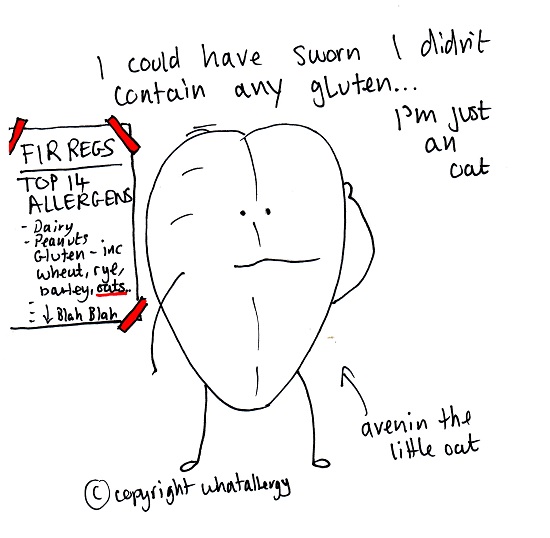
I know that oats don’t contain gluten and many coeliacs can tolerate oats. So why would they be in the Top 14 allergens?
I also know that gluten is not technically an allergen… you can’t be ‘allergic to gluten’ as such but you can have coeliac disease which means you cannot eat any gluten. There is no cure for coeliac disease – the only solution is life long avoidance of all gluten.
Some people are ‘gluten intolerant’ and may have irritable bowel symptoms after eating any foods containing gluten.
I know that gluten covers a range in cereals, including wheat, spelt, rye, barley and kamut. These grains all contain gliadin, the protein in the grain that makes is it such a problem for coeliacs and so amazingly soft, springy and delicious for everyone else who can enjoy bread, cakes and pastry made with gluten containing cereals.
Coeliac UK describe gluten as “A protein that is found in the cereals wheat, barley and rye.” So no mention of oats or kamut there.
Since I have a wheat allergy I know that this is quite a common allergy, yet if you look at the Top 14 allergens that are covered in the Allergen Regulations wheat is not listed but it does come under gluten in the list.
What are the Top 14 allergens?
- Cereals containing gluten, namely: wheat (such as spelt and Khorasan wheat), rye, barley, oats
- Crustaceans for example prawns, crabs, lobster, crayfish
- Eggs
- Fish
- Peanuts
- Soybeans
- Milk
- Nuts; namely almonds, hazelnuts, walnuts, cashews, pecan nuts, Brazil nuts, pistachio nuts, macadamia (or Queensland) nuts
- Celery (including celeriac)
- Mustard
- Sesame
- Sulphur dioxide/sulphites, where added and at a level above 10mg/kg in the finished product. This can be used as a preservative in dried fruit
- Lupin which includes lupin seeds and flour and can be found in types of bread, pastries and pasta
- Molluscs like clams, mussels, whelks, oysters, snails and squid
So what on earth is going on?
Thanks to Michelle Berriedale-Johnson of the Free From Food Awards for trying to explain this to me because I was getting baffled.
This is what she very kindly explained to me:
“It is actually very confusing as effectively oats are classed as both gluten containing and gluten free! Below are the relevant paras from the regs and you will see that oats are included in the ‘cereals containing gluten’ – yet oats are also classified as gluten free provided that they have not been on contact with, and therefore contaminated by, gluten from wheat or other sources… The thinking of those who claim them to be gluten free is that they do not contain gliadin, the protein which ‘causes’ coelaic disease, but avenin which is a very similar protein but not actually the same and therefore can be tolerated by many people who would react to gliadin.
Wheat as such is not in the top 14, but it is one of the cereals containing gluten which are!”
Cereals containing gluten
28. The Regulations (Annex II to EU Regulation No. 1169/2011 as amended by Commission Delegated Regulation (EU) No.78/2014) define these as: wheat (such as spelt and Khorasan wheat), rye, barley and oats or their hybridised strains. Spelt and Khorasan are types of wheat, which are not suitable substitutes for people with coeliac disease and/or wheat allergy.
15
29. Cereals containing gluten will be declared in the ingredients list using the specific name of the cereal, i.e. wheat (such as spelt or Khorasan), rye, barley or oats. Where ‘spelt’, ‘Khorasan’ and ‘Kamut’ have been used; the inclusion of a specific reference to wheat would be required; for example ‘spelt (wheat)’ or ‘Khorasan wheat’ and ‘Kamut (wheat)’.
30. The voluntary inclusion of gluten within the ingredients list following the mandatory declaration of a cereal containing gluten is possible. However, the regulation requires that it is the cereal that should be emphasised, rather than the gluten; for example ‘barley (gluten)’. When using a signpost to allergen information, indicating the presence of cereals containing gluten is also permitted as outlined in the BRC/FDF guidance document.
Thanks again Michelle. This really did help me, sort of.
What it does mean is that Oats should be marked in bold on any packaging and labels for food for retail and food service. I’m not sure the retailers really get this one either as I’m sure oats are not in bold all the time.
Still confused? Me too, and avenin the little oat kernal is confused too.
But I guess it doesn’t really matter as long as people with coeliac disease or a wheat allergy are protected by the new regulations. I think it’s the copy writer in me… I like everything to be just so, correct and accurate and this is just a way of getting gluten and wheat in under one banner because the effect will be the same and kill many birds with one stone. Otherwise it would the Top 15 allergens and contain gluten (for the coeliacs) AND wheat for the (wheat allergics) which is actually a much better number anyway. OR you’d need Allergen regs and Gluten Free regs for coeliacs.
So after much deliberation I have had to accept defeat on this one. The allergen regs do make sense but technically there are a few annoying little discrepancies which make my copywriters eye twitch…
I hope this little blog has helped some of you. It was a good lesson for me.
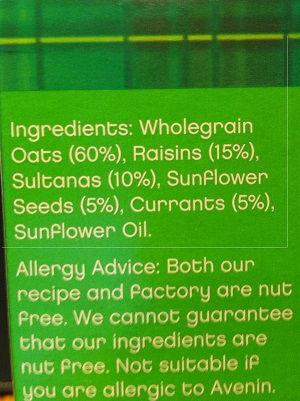



I’m intolerant to both gliadin and avenin so it does annoy me when I see oat products listed as gluten free. Perhaps technically they are but my body treats them in a similar way; as an allergen.
Hi Nathanael, are you a coeliac? I know some people with CD cannot tolerate oats, just like you. I think oats should be always in bold but it does seem confusing that they can be a cereal containing gluten and also gluten free sometimes. You just have to keep vigilant and read all labels. Just out of interest… Which grains do you substitute in place of the gluten and oats?
Little correction, Ruth! … Gluten isn’t an allergen as far as allergen labelling is concerned (as you rightly say, it’s the gluten-containing grain that’s the allergen), but it is an allergen as far as immunology is concerned – i.e., you can be allergic to it.
People with wheat allergy may well be allergic to gliadin – or they may be allergic to a non-gluten protein in wheat instead. I think it’s a different wheat protein which is typically related to exercise induced wheat allergy / anaphylaxis.
I blogged about the oats / gluten and highlighting issue a while back – http://foodallergyandintolerance.blogspot.co.uk/2014/12/hiccups-and-fic-ups.html – and of the examples I gave, I think Udi’s have now corrected, but M&S still are highlighting their ‘gluten’ ….
x
Hmmmm. Yes thanks Alex. This has really confused me. I think I get it now but the words we use are confusing. And I guess since it’s the protein in other foods that people are allergic to, and gliadin is the protein in wheat it could well be that which people are allergic to. I know I react to even wheat with the gluten taken out though so I’m not sure. Curse that codex wheat… I react just as much to that as I do to normal wheat yet it is technically ‘gluten free’. So who knows what I’m reacting to, one protein or both. I also do get exercise induced anaphylaxis just to complicate matters. Thanks for your link above. I will have to correct this blog shortly.
Yes, it’s confusing. It took me ages to get it, and I’ve got it wrong on my blog in the past too. I think a lot of companies have been misadvised regarding oats labelling, due to the confusion.
I don’t know what proteins Codex wheat retains … I will try to look into it.
I’ve answered on my blogpost but in case you see this quicker: yes, oats must always be in bold (or otherwise highlighted), no exception.
We live and learn … I wonder whether it may be better to redefine oats as a non-gluten containing grain, and warn of cross contamination when they are not GF? Will ponder that one …
Thanks Alex… can’t believe I had this oat thing all wrong for so long but I think I’ve got it now but it’s not surprising retailers are confused too. I’m going to go through my cupboards and check all my oat based products as I’m pretty sure the labelling is quite random where it comes to oats.
I had already researched it before I got to this article; The problem is this – the definition of “gluten” which is used synonymously with gliadin in this article; It isn’t so complicated but I find it easier to look at proteins; I will explain
Grains contain proteins called prolamins and they vary from grain to grain :
Wheat = gliadin/glutenin
Rye = secalin
barley = hordein
oats = avenin
But gluten free grains contain prolamins as well – that means corn, sorghum, quinoa, millets, teff, rice
Seems to me the best way to understand “Gluten” is referring to the viscoelastic (the sticky gummy elastic) prolamins and I guess you could call gluten intolerance ‘selective prolamin intolerance’ and in fact some gluten free prolamins might not be totally free of problems from my research. These are sometimes referred to as glutens to o
So gluten is certainly the first three prolamin types but is avenin a gluten? I am not sure if in isolated form avenin has any elastic quality – it’s in a subtle definition if not – certainly it isn’t far enough from the first three that some people won’t have problems but that might be true of corn for a minority. Oats are chemically on the edge basically (this actually varies with oat variety) and if your’e “gluten intolerant” you might not handle them however we define the protein
COMMENT FROM A REGISTERED DIETITIAN, COELIAC SPECIALIST AND COELIAC HERSELF.
I will speak my mind!
Firstly coeliac disease is NOT an ‘allergic’ disease. It is NOT an intolerance either. It might best be described as a ‘sensitivity’. Coeliacs should avoid all gluten contain grains, NOT because they are allergic to them but because they trigger an autoimmune antibody response. In other words, the person’s antibodies target their own tissues once these have been activated by gluten intake. It requires only minute amounts of gluten to do this and the immediate effect several weeks. Sadly in some even trace amounts of gluten can result in very serious long-term and lasting damage. Gluten is not one protein. There are many types of ‘gluten’. This is not a ‘diet fad’ as some think. This is absolutely necessary for the health and indeed survival of those who have this condition.
To add to the problem some coeliacs exhibit something called ‘molecular mimicry’. This means that other proteins, for example, casein in cow’s milk, soy or yeast proteins may also trigger the same antibody response. There are actually several other proteins which may exhibit a similar effect. For these people taking these proteins is just as dangerous as taking gluten. So again, not an allergy and not an intolerance.
The next problem is ‘what is a gluten-containing grain?’. Well according to some of the latest research this probably DOES includes oats and corn, even though many coeliacs eat them. They eat them because 1. They wrongly assume no symptoms means no damage. This MAY not be the case. 2. The gluten-free product manufacturers make a lot of corn-based products, and they sponsor, for example, Coeliac UK, who might lose some of their sponsorship if they suddenly came out as saying coeliacs should not be eating corn! I am waiting to see if there will be a shift in manufacturing practices or policy from Coeliac UK. So far, hardly a comment or whisper about this subject!
From my own experience, many coeliacs have issues with all the ‘gluten grains’ as well as exhibiting problems with cow’s milk and so on. They can also develop a number of serious nutritional deficiencies. They need and MUST have very specific and individual advice from a registered dietitian who has expertise in this area. In fact, only registered dietitians and medical doctors are permitted to advise on specialist, medical therapeutic diets such as these.
Incidentally, it is possible to have coeliac disease AND have an allergy to wheat. These things can all coexist, making diagnosis even harder. There is also a condition called ‘Non-coeliac gluten sensitivity’ (NCGS). This appears to become increasingly common, but to date, there is little available in the way of testing to identify it.
Registered dietitians are degree qualified experts who are able to advise on up to 500 different specialists, medical and therapeutic diets. They have extensive clinical training and are registered with the HCPC (UK). The same professional body who register doctors. They also carry full professional insurance.
What a perfectly succinct and brilliant comment. I couldn’t put it better myself. It’s such a complicated subject. Thanks for explaining it all far better than I could